

Destination guide
Armenia holidays — monasteries, mountains and Yerevan
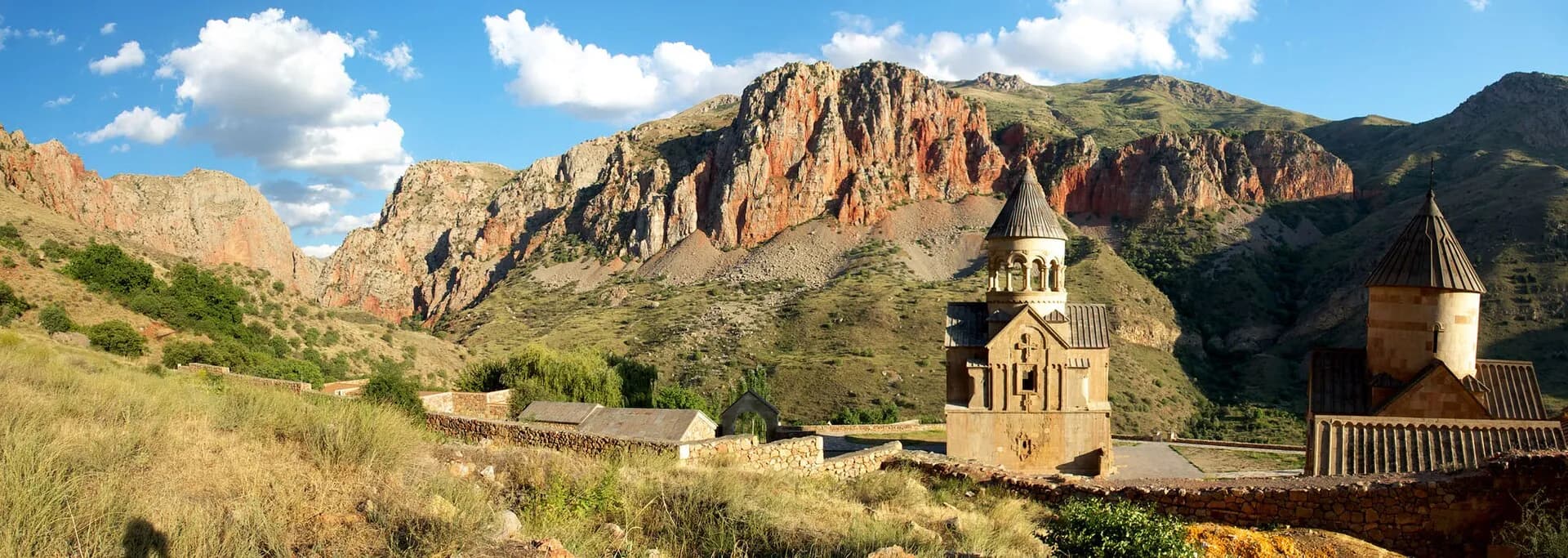
Armenia is a small country in the South Caucasus where a few days are enough to see mountain ranges, deep gorges, the high-altitude Lake Sevan and dozens of monasteries, many of them standing in cliffs and on the edge of precipices. Yerevan is one of the oldest cities in the world, with pink tuff, the Cascade and large museums, and Etchmiadzin, Garni, Geghard and Khor Virap are all easy to reach from it. Beyond that lie Dilijan, Lori, Vayots Dzor and Syunik, where roads cross high passes and the country's history shows in every village and on every cliff.
TripTech will help you choose a flight and a hotel, and put together a route across Armenia for your dates, so the trip stays comfortable and free of unnecessary transfers.
Where to go in Armenia
- 01
The Cascade and Republic Square — see Yerevan from centre to viewpoints
The Cascade is a long stairway with fountains and exhibition halls that climbs from the centre to the viewpoints, where a panorama of the city and Mount Ararat opens up. Below it lies Republic Square, with government buildings, the singing fountains and evening lights. Cafes and galleries line the streets between them, so it is easy to walk the whole stretch and come back at sunset.
- 02
Matenadaran and Vernissage — from manuscripts to a city market
Matenadaran holds a large collection of Armenian manuscripts, with halls showing parchments, miniatures and old books in carved bindings. Nearby, by Republic Square, the Vernissage market sells carpets, silver, jugs and old records, and it becomes especially lively at weekends. Together the two places show how museums and everyday trade sit side by side in Yerevan.
- 03
Etchmiadzin and Zvartnots — the spiritual centre and ancient ruins
Etchmiadzin is the centre of the Armenian Apostolic Church, with the main cathedral, the residence of the Catholicos and a museum treasury of relics. A few minutes away lie the ruins of Zvartnots, a round seventh-century temple of which columns, an altar and carved capitals survive. Both sites are close to Yerevan, so they fit easily into one day with a return to the city in the evening.
- 04
Khor Virap and Ararat — see the country's most famous mountain
Khor Virap is a monastery on a hill in the Ararat plain, and from it you get one of the best-known views of Mount Ararat. Tradition says that Gregory the Illuminator was held in a pit here, and visitors can still climb down a narrow stairway into it. The site lies on the road south from Yerevan, so it is usually combined with a trip to Areni, Gladzor and Noravank.
- 05
Amberd — climb to a medieval fortress above a gorge
Amberd is a medieval fortress on the slope of Mount Aragats at around two thousand metres, where walls, gates and a small church survive. It stands where river gorges meet, with alpine meadows around it that offer cool air in summer. The road climbs in hairpins, so the trip is best planned for the warm season and with time to spare.
- 06
Garni and the Symphony of Stones — walk between basalt columns
Garni is the only pagan temple preserved in Armenia, dedicated to Mithra in the first century and standing on the edge of the Azat gorge. Nearby you can see the remains of fortress walls, a bath house with a mosaic and a palace. Further down the gorge runs the Symphony of Stones, basalt columns rising in even rows, reached by a trail that deserves its own time.
- 07
Geghard — see a monastery carved into the rock
Geghard is a monastery complex of the twelfth and thirteenth centuries, part of it cut straight into the cliff of the Goght gorge. Churches, tombs and halls sit inside the stone, so the rooms stay dark and cool and the sound of water follows you. High rock walls surround the complex, and the road climbs up from the valley, where most travellers pause before the ascent. Visit in the morning, together with Garni.
- 08
Lake Sevan and Sevanavank — rest by a high mountain lake
Sevan is one of the highest large lakes in the world, cold even in summer, with beaches, cliffs and empty peninsulas along its shores. On a peninsula stands Sevanavank, a small tenth-century monastery on a hill with a panorama of water and mountains. People come to swim, walk the shore and try Sevan trout in the cafes along the road.
- 09
Dilijan and Haghartsin — walk the forests of Tavush
Dilijan is a town in the Agstev valley, surrounded by forests and old quarters with wooden houses and carved balconies. From here it is easy to reach Haghartsin, a monastery in the forest with domes, khachkars and old slabs. The roads around run through gorges and past viewpoints, and the cool air makes the area good for unhurried walks.
- 10
Haghpat, Sanahin and Akhtala — link the monasteries of Lori
In Lori, in the Debed valley, stand two large twelfth-century monasteries, Haghpat and Sanahin, whose bell towers, libraries and khachkars are listed as World Heritage. Nearby, in a gorge, lies Akhtala, a fortress and church with frescoes that have survived since the thirteenth century. Roads run between them through the canyon, and in the village below Haghpat people bake bread and make cheese.
- 11
Gyumri and Shirak — see Armenia beyond the capital
Gyumri is the country's second city, with nineteenth-century quarters of black tuff, craft workshops and inner courtyards. Here you can see the Black Fortress, several museums and a lively market, while a walk through the centre shows an Armenia quite unlike the capital. The surrounding Shirak is a plateau of lakes, old churches and mountains that deserves a day of its own.
- 12
Noravank — see a monastery in a red gorge
Noravank is a fourteenth-century monastery standing on a ledge above the Arpa gorge, among red and ochre cliffs. Its main church is known for stone carving and reliefs, and steep canyon walls rise above the walls of the complex. The road climbs in hairpins and ends at a viewpoint that takes in the whole monastery and the valley with its vineyards.
- 13
Gladzor and Areni — a medieval university and a cave
Gladzor is a thirteenth-century monastery where one of medieval Armenia's major teaching centres worked, copying and illuminating manuscripts; walls, a church and khachkars remain. Below, in the village of Areni, a cave was found to hold an ancient shoe and a wine-making site, and vineyards surround it. The pair makes a good day that joins history and wine.
- 14
Jermuk — drink from the springs and walk to the waterfall
Jermuk is a mountain resort in Vayots Dzor known for its mineral springs, sanatoriums and cool summers. The town has a waterfall reached by a trail along the Arpa gorge, and a gallery where you can fill bottles from the springs. People come to drink the water, swim in the pools and walk in the forest, and in winter to ski.
- 15
Zorats Karer (Karahunj) — look at the ancient stones of Syunik
Zorats Karer, also called Karahunj, is an ancient structure of dozens of large stones with round holes, set in rings and rows on a plateau in Syunik. Scholars still argue about its age and purpose: some see an observatory, others a necropolis. The site is open and windy, with a wide view of the mountains, so bring a jacket. The road to Tatev runs close by.
- 16
Tatev and the cable car — fly over a deep gorge
Tatev is a ninth-century monastery on the edge of a deep gorge, reached by one of the world's longest passenger cable cars: the cabin runs from the village of Halidzor above the void, with the river far below. The monastery keeps a church, a bell tower and the famous swinging gavazan column, and trails lead to a waterfall and caves. The ride itself is part of the experience.
Resorts and cities
What else is worth trying
Try Armenian food
dolma, khash, kufta, lavash baked in a tonir and vegetables from the market — best in small family places rather than hotels.
Join a table
toasts are made in turn and nobody hurries, so dinner can last for hours; leave the evening free.
Taste the wine and brandy
Areni and the Vayots Dzor area make wine from local grapes, and the distilleries of Yerevan and Gyumri offer tastings.
Hire a driver for the monasteries
mountain roads are narrow and winding, so for remote sites a car with a driver is calmer than driving yourself.
Do not rush the transfers
distances on the map are deceptive: passes and hairpins take longer than they look, so two or three stops a day is plenty.
Before your trip
Weather in Armenia depends on altitude: Yerevan is dry and hot in summer, the mountains are cooler, and on the passes and by Lake Sevan you need warm clothes even in July. The best months are May, June, September and October, when the heat is not exhausting. Wine and brandy are a world of their own: vineyards in Vayots Dzor run tastings and Yerevan and Gyumri have brandy distilleries, and after either it is better not to drive. Mountain roads are narrow and sometimes unmarked, so choose your driver with care. Money is changed in banks and exchange offices, cards are widely accepted, but cash helps at markets and in villages. And remember the hospitality: refusing coffee or a toast reads as coldness here, and a feast can last until late at night.
Frequently asked questions
When is the best time to visit Armenia?
From late spring into early summer and again in September and October: the heat is milder and the passes are open. In summer Yerevan often climbs above thirty degrees, while the mountains and Lake Sevan stay cool. Winter is quiet in the cities, and snow can close the high roads.
How many days do you need in Armenia?
Three or four days cover Yerevan and its surroundings; a week or two is better for the whole country with Sevan, Lori, Vayots Dzor and Syunik. Two to four stops fit into a day: distances are short, but the roads take time.
Should you choose Yerevan or the monasteries?
They are two halves of the same trip. Yerevan gives you museums, cafes and city rhythm, while the monasteries and mountains are the main reason people come. A comfortable plan is to stay in the capital and take day trips towards Garni, Geghard, Sevan or Dilijan, then head south with an overnight stop.
How do you get around Armenia?
Buses and minibuses link the towns, but for distant monasteries a car with a driver or a rental works better. Yerevan has a metro and taxis, while public transport outside the city is sparse, so plan the route in advance.
Information about places and trip conditions may change or be out of date. Please verify the latest details before you travel.
Photograph: Alexander Naumov · CC BY 3.0 · Wikimedia Commons