

Destination guide
Uzbekistan holidays — Silk Road cities and desert
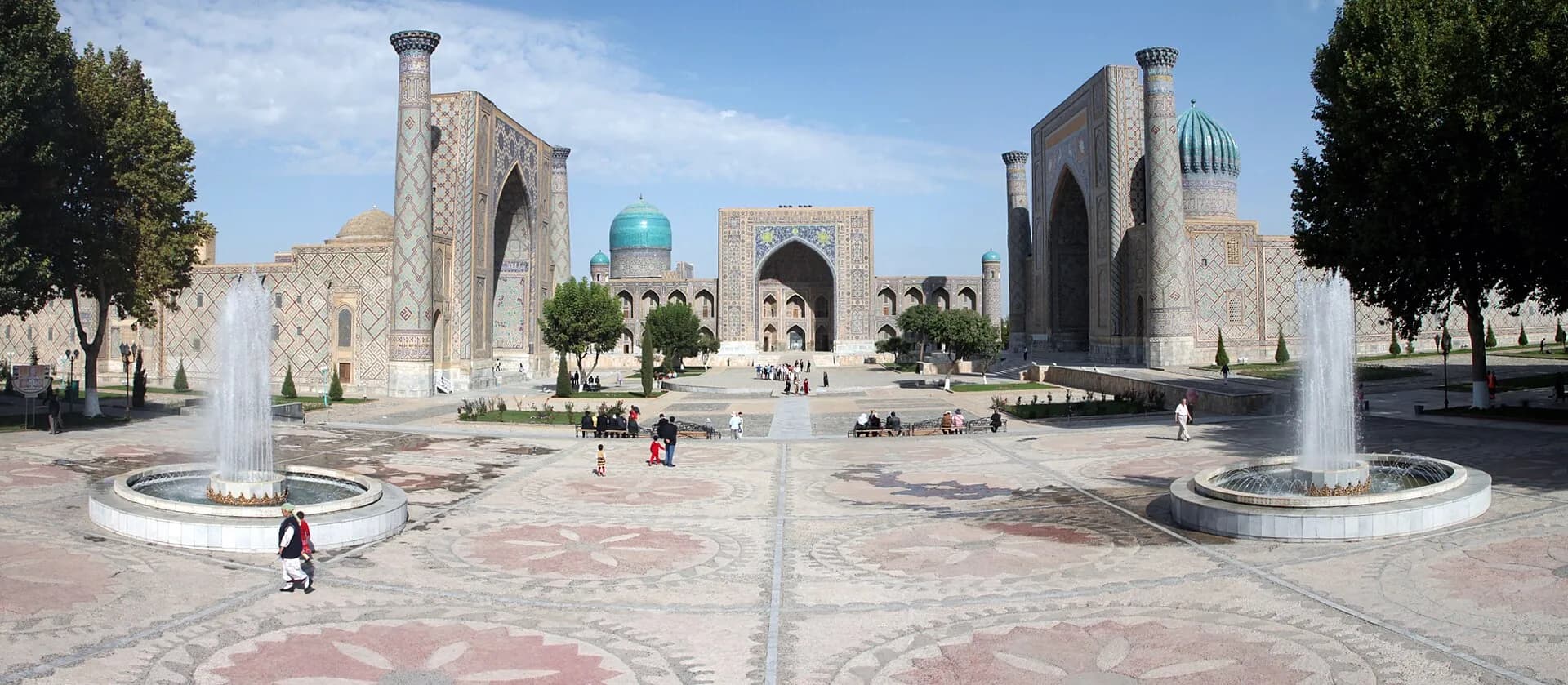
Uzbekistan is a country of Silk Road cities: Samarkand, Bukhara and Khiva stand on old trade routes, with the Kyzylkum desert and the foothills of the Tian Shan in between. People come for tile domes, mud-brick quarters and madrasas, for fruit and plov, for the cool of mountain lakes and the unusual quiet of the Aral Sea. Allow enough time to see both the big cities and the desert.
TripTech will help you choose a flight and a hotel and put together a route between Tashkent, Samarkand, Bukhara and Khiva for your dates, so travelling around Uzbekistan stays comfortable and free of unnecessary transfers.
Where to go in Uzbekistan
- 01
Khast-Imam — see the oldest shrines of Tashkent
An architectural complex in the old part of Tashkent, formed around the mausoleum of the saint Kaffal Shashi. It holds the Barak Khan Madrasa, the Hazrati Imam Mosque and a library keeping one of the oldest copies of the Quran. The place feels local rather than touristy: residents come here, and the courtyards stay quiet even at weekends. Old quarters survive around the complex and are pleasant to walk through afterwards.
- 02
Chorsu Bazaar — step into everyday Tashkent
A large domed market in the centre of old Tashkent, where traders sell flatbread, dried apricots, spices, pomegranates and herbs. A square with a metro station surrounds the bazaar, so it is easy to stop by on the way to other sights. Come in the morning, while the stalls are full and the heat has not set in yet. You can also buy souvenirs and tea here, and traders are happy to say where their goods come from.
- 03
Chimgan and Charvak — trade the city for mountains and water
A mountain area in Tashkent region, visited for a day or a weekend: the Chimgan ridge with its chairlift, green slopes and the Charvak Reservoir with its holiday camps. Here you can walk the trails, ride horses, climb to viewpoints and swim by the water. The road from Tashkent is short, which makes it a popular dawn trip.
- 04
Khudoyar Khan Palace — understand the Kokand khanate
A palace complex in Kokand built in the 19th century under Umar Khan and Khudoyar Khan, with a richly decorated facade, carved ganch and an inner courtyard. A mosque and a minaret stand nearby, and the historic centre is small and easy to walk. Kokand lies in the Fergana Valley, so it fits naturally into a trip around the valley.
- 05
Registan — stand on the square of the Silk Road
The main square of Samarkand, framed by three madrasas: Ulugbek, Sher-Dor and Tilla-Kari. Turquoise domes, portals and tile ornament are visible from every corner, and the lights come on in the evening. The square is still the heart of the city, with workshops, souvenir shops and cafés around it, so it is easy to wander here between excursions.
- 06
Gur-Emir — see the tomb of Tamerlane
A mausoleum in Samarkand where Amir Timur and his descendants, including Ulugbek, are buried. Inside are a tall domed hall, marble tombstones and gold painting, while outside the building is recognised by its ribbed turquoise dome. It is a short but powerful stop, best seen together with the Registan. A short street with souvenir shops links the square and the mausoleum.
- 07
Shah-i-Zinda — walk the avenue of mausoleums
A necropolis on a hillside in Samarkand, made up of dozens of mausoleums built over several centuries. The narrow passage between them and the abundance of majolica and tiles make the walk unlike any other monument in the city. Go up early, when few people are in the lane and the mosaic on the portals is easy to see. The site remains a place of memory, so keep the visit quiet.
- 08
Bibi-Khanym — see Timur's congregational mosque
A huge mosque built in Samarkand under Amir Timur after his campaigns, with a monumental portal, domes and an inner courtyard. Part of the structure was damaged by earthquakes, which gives the ensemble a dramatic look. The Siab Bazaar is next door, so the walk can continue there with a taste of local flatbread. From the square the whole ensemble is visible, but up close it is far more interesting.
- 09
Ak-Saray — picture Timur's palace in full
The ruins of a palace in Shahrisabz built under Amir Timur, of which massive pylons and fragments of the portal remain. The scale of the entrance is clear even now: there were once huge arches here, and the walls were covered with blue and white tiles. Shahrisabz lies on the road between Samarkand and Termez, so travellers often stop for half a day. The town also has other Timurid monuments and tombs.
- 10
Fayaz-Tepe — find a Buddhist monastery in the south
An archaeological site near Termez, a Buddhist monastery of the first centuries AD. Here you can see the remains of cells, stupas and shrines, while finds from the excavations show how many cultures met at this crossroads. The place is quiet and almost empty, which makes it worth adding to a route for a different, little-known side of Uzbekistan.
- 11
Poi-Kalyan — hear the heart of Bukhara
An ensemble in the centre of Bukhara that includes the Kalyan Minaret, the congregational mosque and the Mir-i-Arab Madrasa. The 12th-century minaret can be seen from any street, and the square in front of it is always busy. The ensemble is easiest to explore in the morning or towards evening, when the light warms the brickwork. Old trading rows and many workshops survive at the foot of the minaret.
- 12
Ark Citadel — walk the walls of the Bukhara emirs
An ancient fortress and the residence of the rulers of Bukhara, standing above the city on a raised mound. Behind the walls are palaces, a mosque and museums telling the story of the emirate, while the ramparts give a wide view over old Bukhara. The climb to the gate is short, but there is little shade, so avoid the midday heat.
- 13
Lyab-i Hauz — sit by the water in central Bukhara
A square around an old pond with a stone bank, framed by madrasas and old plane trees. There are many tea houses and small shops here, so the spot suits a pause between walks: you can drink tea, watch people and rest in the shade. In the evening the square comes alive, while in the daytime it stays calm. Souvenir shops and old madrasas stand around it.
- 14
Aidarkul — relax by a lake in the middle of the Kyzylkum
A large lake in Navoi region that appeared in the desert and is surrounded by sand and low hills. In summer people swim, take boats out and stay in yurt camps, while anglers go after carp and catfish. Sunsets over the water and the silence of the Kyzylkum make this a good pause between the ancient cities. The shores are sandy and the water warms up by early summer.
- 15
Ichan-Kala — get lost in ancient Khiva
The inner town of Khiva, ringed by mud-brick walls and listed as a World Heritage site. Inside are madrasas, mosques, minarets and narrow lanes where cars are almost absent, and lanterns come on in the evening. The best approach is simply to walk, step into courtyards and climb the towers for a view over the town. The walls and domes are lit at night, and Khiva looks completely different.
- 16
Muynak and the Aral Sea — see the sea that left
A town in Karakalpakstan that was once a port and now stands far from the water: instead of a quay there is a salt flat and rusty ships. The museum and the ship graveyard tell what happened to the Aral Sea, and a trip across the Ustyurt plateau shows a harsh and empty beauty. The place is heavy in meaning, and that is exactly why it stays with you.
Resorts and cities
What else is worth trying
Try plov
real Uzbek plov is cooked in a kazan and differs from town to town: rice, carrots, meat and cumin, served with green tea.
Sit in a tea house
a slow pot of tea with flatbread, dried fruit and sweets is the local way to wait out the heat and talk.
Hire a car with a driver
for the mountains, the lakes and the Aral Sea, where public transport is rare and slow.
Plan the city route
Tashkent, Samarkand, Bukhara and Khiva form a logical chain, but leave a few days without excursions between them.
Buy ceramics and fabric
Rishtan and Margilan are known for pottery and silk, and bazaars are good for atlas silk, cotton and hammered metal.
Before your trip
Spring and autumn are the best seasons: summer is very hot in the desert and the cities, while winter is cold and damp in the north. Trains and flights link Tashkent, Samarkand, Bukhara and Khiva, and a car is the practical way to reach the mountains, the lakes and the Aral Sea. Cash matters in villages, at bazaars and in small cafés, though cards are accepted more often in the cities. In working mosques and mausoleums, dress modestly: cover shoulders and knees, and women may need a scarf. Tea is drunk often and in quantity, plov is ordered for a group, and it is worth asking locals where the best plov is. Foreign visitors should remember temporary registration: hotels usually arrange it, but keep your passport with you.
Frequently asked questions
When is the best time to visit Uzbekistan?
April and May or September and October suit the Silk Road cities best: the days are warm, the evenings cool and the bazaars full of fruit. Summer is very hot in Bukhara and Khiva, though the mountains and lakes are more comfortable then, and winter is colder and quieter in Tashkent and Samarkand.
How many days do you need in Uzbekistan?
A week is enough for Tashkent, Samarkand and Bukhara at a relaxed pace. The classic four-city route takes about ten to twelve days, and with the Fergana Valley, the mountains and the Aral Sea it is worth allowing two weeks or more.
Should you choose Samarkand, Bukhara and Khiva or the countryside?
They are different trips. The cities are about madrasas, tiles, bazaars and history; nature is about Chimgan, Aidarkul, the Kyzylkum and the Aral Sea. With limited time, the cities make more sense, and nature can wait for a second visit or a day or two at the end of the route.
How do you get around Uzbekistan?
Trains and domestic flights are convenient between Tashkent, Samarkand, Bukhara and Khiva. Within towns it is easy to take a taxi, for natural sites a car with a driver is better, and airports and stations sit close to the centres.
Information about places and trip conditions may change or be out of date. Please verify the latest details before you travel.
Photograph: Stomac · CC BY-SA 2.0 fr · Wikimedia Commons