

Destination guide
China — from imperial capitals to tropical islands
China packs several trips into one country: imperial Beijing with the Forbidden City and the Temple of Heaven, Shanghai's waterfront and gardens, the Terracotta Army in Xi'an, the pandas of Chengdu, the karst peaks around Guilin and the sandstone pillars of Zhangjiajie. Classical gardens in Suzhou, the tea hills of Hangzhou, the old walled town of Pingyao and the beaches of Hainan add very different days, from slow walks to mountain trails.
TripTech helps you choose flights and hotels and puts together a route for your dates, so the distances between cities do not turn the trip into endless transfers.
Where to go in China
- 01
Forbidden City — see the palaces of imperial Beijing
The palace complex in central Beijing where emperors of the Ming and Qing dynasties lived and ruled for almost five centuries. Behind the gates come courtyards, halls and terraces, so it makes sense to follow the central axis. Afterwards, climb Jingshan Hill for a view over the golden roofs below.
- 02
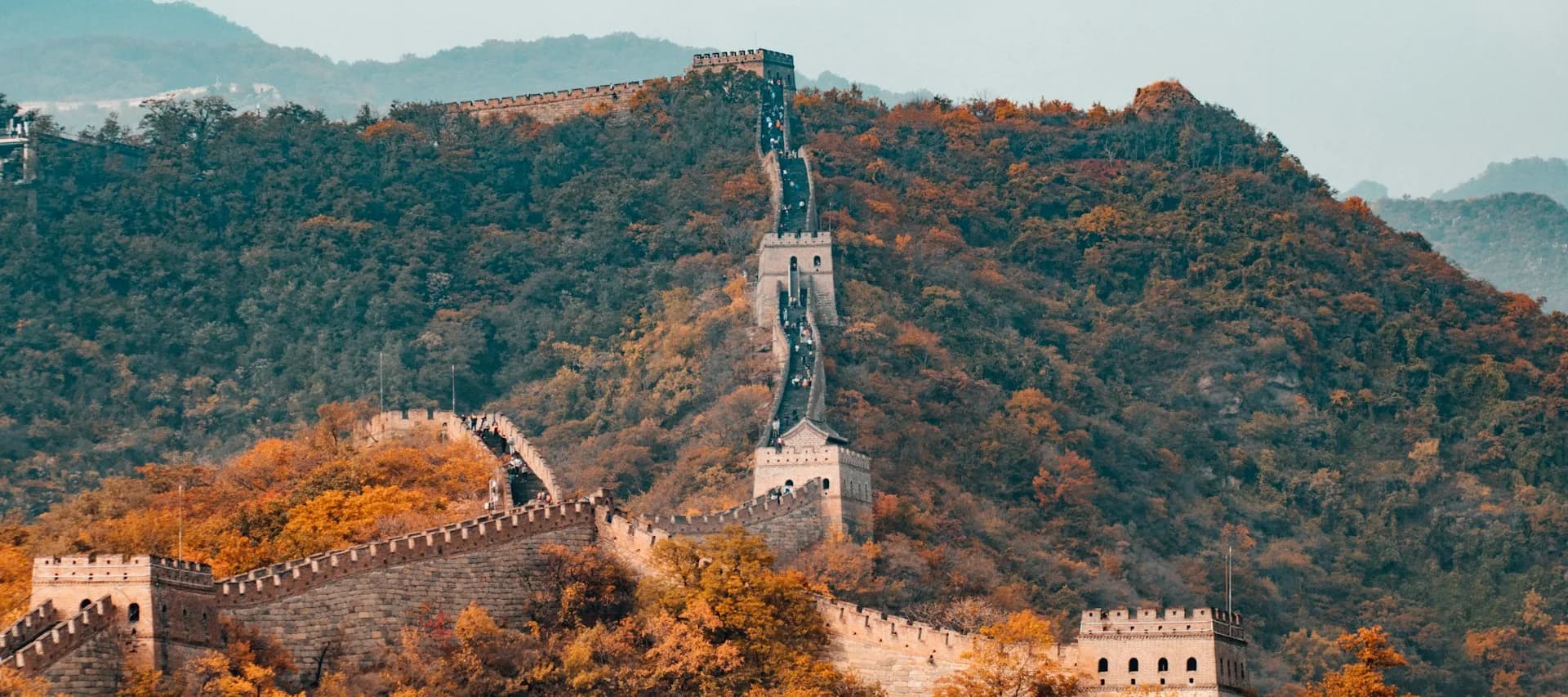
Great Wall at Mutianyu — walk the ridge above the forest
A restored stretch of the wall north of Beijing, known for its watchtowers and wide views over the hills, with a cable car to ease the climb. You can walk several kilometres along the ridge and get a sense of the scale of the fortification. Wear comfortable shoes: some sections are steep.
- 03
Temple of Heaven — see where emperors prayed for the harvest
A complex in southern Beijing where emperors prayed for good harvests, also known as Tian Tan. The main hall on its three-tiered terrace is one of China's most recognisable buildings, and the park around it has become a place for residents' morning exercise. History and everyday city life sit side by side here.
- 04
Summer Palace — wander an imperial park by the lake
A park of palaces, pavilions and the large Kunming Lake, used by Qing emperors as a retreat from the city. Walk the Long Corridor and look up at the Buddhist buildings on the hillside above. The grounds are large, so allow a few hours.
- 05
The Bund — see Shanghai's historic waterfront
The riverside promenade on the Huangpu, where 1920s colonial buildings face the skyscrapers of Pudong across the water. People come at sunset, when the towers light up and the river changes colour. It is a good place to start a walk through the city before heading into the old streets behind it.
- 06
Yu Garden — find a classical Shanghai garden
A 16th-century garden in Shanghai's old town, built around ponds, rockeries and pavilions. Behind the walls of the busy bazaar around it, a quiet network of paths and small bridges opens up. The garden is compact, so it feels calmer early and late in the day than at midday.
- 07
Terracotta Army — meet the clay soldiers of the first emperor
Thousands of clay soldiers found near the tomb of Qin Shi Huang, China's first emperor, outside Xi'an. The figures stand in battle formation, and each has its own face and details of equipment. They are shown in several large halls, with some left in the excavation pits and others rebuilt after restoration.
- 08
Chengdu pandas — see bamboo bears up close
A park in Chengdu that keeps and studies giant pandas, alongside red pandas and other rare animals. Young pandas play and climb a great deal, so the enclosures are rarely dull. Mornings are the best time to visit, when the animals are more active and there are fewer visitors.
- 09
Guilin and Yangshuo — drift between karst peaks
The Li River between Guilin and Yangshuo runs through limestone hills that are worth seeing both from the water and from the shore. Give the river trip half a day, then hire a bicycle in Yangshuo and ride out to the villages on quiet roads. After rain the peaks are wrapped in mist and the landscape turns softer.
- 10
Zhangjiajie — climb among sandstone pillars
A national park in Hunan province known for hundreds of vertical cliffs, glass walkways and hanging bridges. The lift on Bailong Cliff takes you quickly up to the viewpoints, where the stone forest opens below. Staying in a village near the entrance saves time on the road.
- 11
Hangzhou and West Lake — walk the shore and see the tea hills
A lake in Hangzhou ringed by causeways, pagodas and gardens, with Longjing tea plantations just beyond. It is easy to walk or cycle around the water, stopping at the pavilions along the way. Further out, the plantations are worth a visit and a taste of green tea.
- 12
Suzhou gardens — understand the classical Chinese garden
Dozens of gardens survive in Suzhou, but the Humble Administrator's Garden and the Master of the Nets Garden give a full picture of the style. Water, stones, walls and pavilions are arranged so that every turn opens a new view. Suzhou is easy to combine with a high-speed train from Shanghai.
- 13
Hong Kong — see skyscrapers, a harbour and mountains side by side
A former British port that packs a dense city between its harbour and green hills. From the centre you can ride up Victoria Peak for the skyline, then head to an island beach or a park on the hillside. The markets and street food deserve time of their own.
- 14
Hainan — relax by the sea in a tropical climate
An island in the south of the country with warm water, sandy beaches and palm groves. Most hotels are in Sanya, while quieter bays lie to the north. Swim where lifeguards are on duty and keep the frequent summer rain in mind.
- 15
Lhasa and the Potala Palace — see the Buddhist heart of Tibet
The Potala Palace stands above Lhasa and is one of the region's main Buddhist monuments. Inside are galleries and halls, while pilgrims gather in the square below in the morning. Lhasa sits high in the mountains, so take the first days slowly to acclimatise.
- 16
Pingyao — walk the old streets of a merchant town
A city in Shanxi that keeps its walls, old banks, merchant houses and paved lanes. It is a place to wander between courtyards and watch the life of a small historic town. Pingyao is compact, so a day or two fits easily into a route from Beijing or Xi'an.
Resorts and cities
What else is worth trying
Eat by region
the food changes with the province: Peking duck in Beijing, noodles in Xi'an, hotpot in Chengdu and dim sum in Hong Kong.
Use the high-speed trains
they link Beijing, Xi'an, Shanghai, Hangzhou and Suzhou, but seats for your dates are worth booking in advance.
Step into a teahouse
in Hangzhou or Chengdu the tea is brewed in front of you, which is a calm way to meet the local pace.
Keep your phone ready
maps, taxis and cashless payment in big cities live in apps, so set them up before you go.
Try street food
the best stalls cook in front of you and draw a queue of locals, and a market dinner can be built from small portions.
Before your trip
China is huge, so the weather depends on the region and the season: spring and autumn suit Beijing and Xi'an, summer brings heat and rain, and Hainan stays warm for most of the year. Temples and some sites ask for modest dress, and city days involve a lot of walking, so bring comfortable shoes and a light jacket. High-speed trains and flights are the easiest way between regions, with buses for shorter hops. Carry a little cash for small expenses, set up map and payment apps before you go, and check current information on official sources.
Frequently asked questions
When is the best time to visit China?
It depends on the route. Spring and autumn are more comfortable for Beijing, Xi'an and the Yangtze delta cities, when the days are less hot. Summer suits Hainan and the mountain areas, but the big cities are hot and rainy then. Winter is cold and dry in the north and mild in the south.
How many days do you need in China?
Three to five days usually cover one city, while a route through Beijing, Xi'an and Shanghai deserves about two weeks. Adding Guilin, Zhangjiajie or Hainan needs more time. Distances between cities are long, so fewer transfers mean more of the trip itself.
Beijing or Shanghai?
They are different journeys. Beijing is about imperial history, palaces and hutongs, Shanghai about modern architecture, the waterfront and gardens. If time allows, see both and link them by high-speed train or a short flight.
How do you get around China?
High-speed trains and flights work best between the big cities, with buses for shorter distances. Inside cities, metros, taxis and ride-hailing apps do the job. Train seats are worth booking in advance, especially around public holidays.
Information about places and trip conditions may change or be out of date. Please verify the latest details before you travel.