

Destination guide
Singapore holidays — a city-state of districts
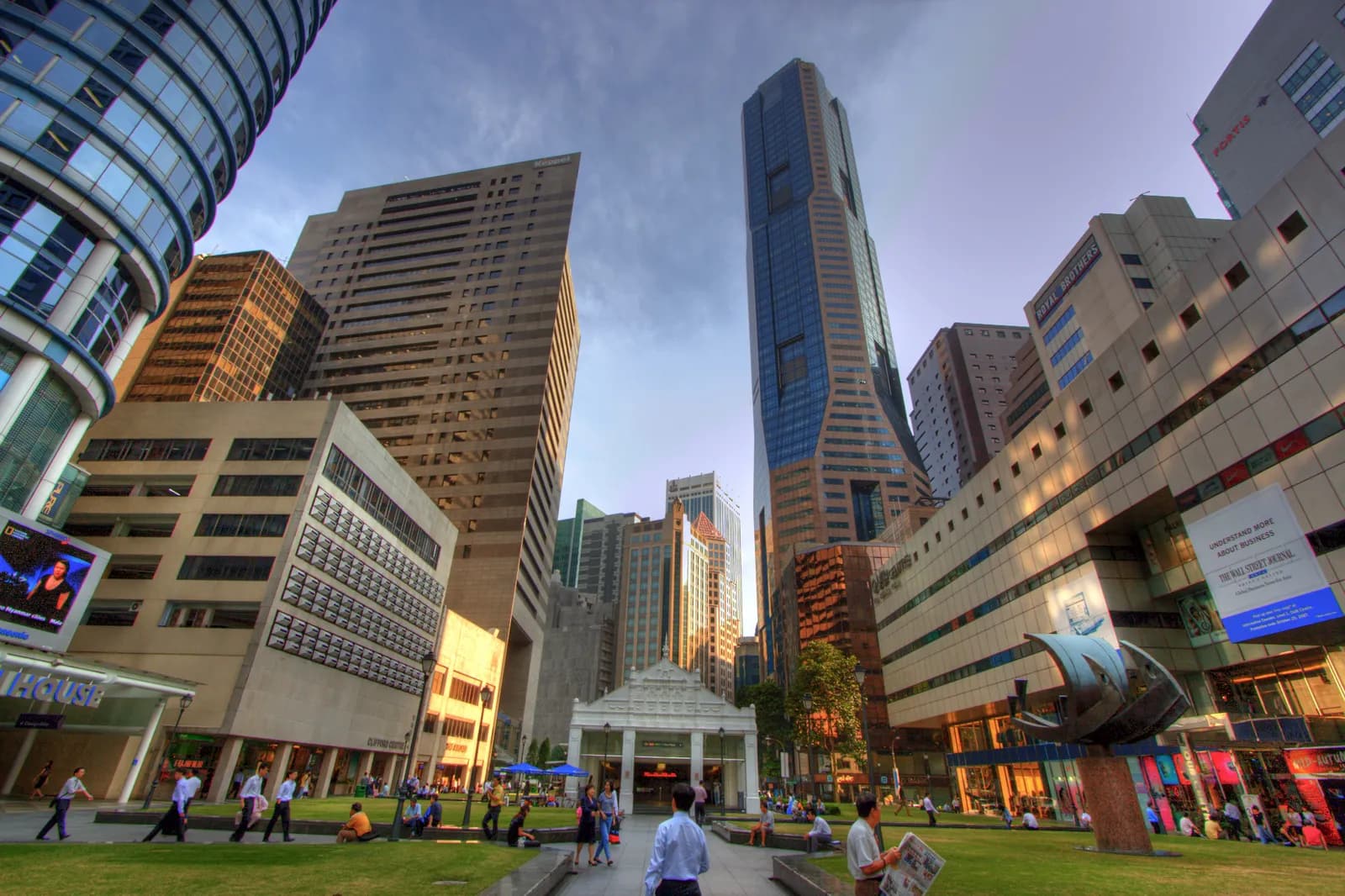
Singapore is a city-state on an island at the southern tip of the Malay Peninsula, where a single trip can cover almost every main district by foot and MRT: Marina Bay with its towers and gardens, the colonial Civic District, Chinatown, Little India, Kampong Glam, Orchard Road, the Botanic Gardens, Sentosa and the green edges of Mandai. The climate is tropical, the streets are orderly, and the distances between districts are short, so the route is easy to build district by district.
TripTech will help you choose a flight and a hotel and put together a route across the districts for your dates, so travelling in Singapore stays comfortable and free of unnecessary transfers.
Where to go in Singapore
- 01
Marina Bay and Gardens by the Bay — see the city of the future
The main modern district around the bay: Marina Bay Sands with the SkyPark observation deck on its roof, the glasshouses of Gardens by the Bay and the Supertree Grove, which is lit up after dark. A wide promenade runs around the water and boats cross the bay. Come twice — in daylight to walk the gardens and in the evening, when the light show begins.
- 02
Merlion Park — meet the symbol of the city
A small park at the mouth of the Singapore River, home to the white Merlion, a creature with a lion's head and a fish tail that serves as the city's official symbol. The platform looks out over Marina Bay, the financial district and the Esplanade, so almost everyone stops for a photo. Come early in the morning or close to sunset, when the heat eases and the light is softer.
- 03
Esplanade — see the theatre on the bay
A concert complex on the waterfront, known for its aluminium domes that people compare to two halves of a durian. Inside are halls for music and theatre; outside there is a promenade facing Marina Bay and an open stage that hosts free concerts. Some come for a performance, others just to sit by the water in the evening when the city is lit up.
- 04
National Gallery — get to know the art of the region
The largest museum of Southeast Asian art, housed in two historic buildings — the former City Hall and the former Supreme Court. The collection covers artists from the region from the 19th century to the present, and the colonnaded upper floors open onto views of the square and the cathedral. On a hot day it is a good place to spend a few hours, pairing exhibitions with a walk around the Civic District.
- 05
Clarke Quay and Boat Quay — spend an evening by the river
Two stretches of the old waterfront at the mouth of the Singapore River: once a trading port, now a district of restaurants, bars and promenades. Boats run along the water, bridges cross the river, and old warehouses with colonnades have become restaurants and hotels. Weekdays are calmer than weekends, and in the evening the lights come on and the views open up.
- 06
Chinatown and the Buddha Tooth Relic Temple — step into the old city
A historic Chinese quarter of shopping streets, old shophouses and temples. The main sight is the Buddha Tooth Relic Temple with its relic and small museum; nearby stand the Sri Mariamman Temple and Jamae Mosque, and the hill keeps houses with carved facades. Look into the lanes around Ann Siang Hill, where cafés sit next to small workshops.
- 07
Peranakan Museum — understand the local culture
A small museum in a restored former school on Armenian Street, devoted to the Peranakans — descendants of Chinese settlers who put down roots in Singapore and Malacca. The collection includes porcelain, embroidery, jewellery, furniture and objects from wedding ceremonies. Afterwards walk to the Armenian Church and up into Fort Canning Park for a view over the city.
- 08
Little India — feel another side of Singapore
The neighbourhood around Serangoon Road, home to the Indian community: bright facades, flower garlands, shops selling spices and fabric, and the Sri Veeramakaliamman Temple. Here too are the rainbow walls of the House of Tan Teng Niah and Tekka Centre, where dosa, chapati and other Indian dishes are cooked. Explore it on foot, stepping into courtyards and shops, to see how the city's communities live side by side.
- 09
Kampong Glam and Sultan Mosque — see the Malay quarter
The old Malay quarter around the Sultan Mosque, with its large golden dome. Arab Street and Bussorah Street are lined with carpet and perfume shops, cafés and restaurants, while the Malay Heritage Centre occupies the former Kampong Glam palace. Haji Lane, with its boutiques and street art, starts nearby, so the two are usually seen on the same day.
- 10
Orchard Road — walk the main shopping street
The city's main shopping street, running for about two kilometres: malls, boutiques, cafés and cinemas line a palm-lined boulevard. In the side streets, rows of old houses survive, for example on Emerald Hill, where small bars and restaurants now operate. In the evening the street is lit up, and on weekdays it is noticeably quieter than at the weekend.
- 11
Botanic Gardens and the National Orchid Garden — rest among greenery
The city's oldest tropical garden, listed as a UNESCO World Heritage Site: broad lawns, a lake with swans, a patch of real rainforest and paths under the palms. A separate part of the garden is the National Orchid Garden, with hundreds of varieties, including hybrid cultivars. People come here to escape the city, so allow half a day and carry water.
- 12
Sentosa — spend a day on the island of fun
An island south of the centre, linked to HarbourFront by cable car, bridge and MRT. It holds Universal Studios with its rides, the beaches of Siloso and Tanjong Beach, an aquarium and several lookouts. Most people give it a full day to combine swimming, attractions and a walk along the waterfront, and take the cable car back in the evening.
- 13
Southern Ridges and Henderson Waves — walk above the jungle
A walking route over the hills from Mount Faber Park to Kent Ridge Park, passing through forest and lookouts. Its best-known section is the wavy Henderson Waves bridge, which spans the road below. Along the way there are boardwalks and benches, with views over the port and the city; walk it one way and take a bus back.
- 14
Singapore Zoo and River Safari — see animals without cages
The zoo in Mandai is known for open enclosures: animals live among greenery and paths wind between the zones. Next door is River Safari, with freshwater aquariums, manatees and river giants. Both parks are large, so arrive around opening time to cover them before the midday heat and plan for a full day.
- 15
Pulau Ubin — see another Singapore
A small island in the north-east, reached by boat from Changi Point Ferry Terminal. There are almost no high-rises here: dirt tracks, wooden kampong houses, mangrove forests and the Chek Jawa wetlands with their boardwalks. The island is easiest to explore by bicycle, rented near the jetty, and afterwards you can return to Changi for dinner by the water.
- 16
Jewel Changi — see a waterfall inside the airport
A glass dome beside the terminals at Changi Airport, where a waterfall about forty metres high drops into a terraced garden. Around it are shops, cafés and walkways, and the upper levels hold planted terraces. Jewel is easy to visit on the day you arrive or before a flight, when a few hours remain until departure.
What else is worth trying
Eat at a hawker centre
chicken rice, laksa, char kway teow and satay are best tried at hawker centres such as Maxwell or Lau Pa Sat, where local cooks do the work.
Ride the MRT
the metro is clean and punctual, trips between districts take minutes, and you can tap a bank card at the gates.
See the city from the water
a boat along the river or the bay shows Marina Bay and the old quays from a different angle.
Go on the Night Safari
the Night Safari in Mandai shows the animals' night life, and the visit takes the whole evening, so plan the day around it.
Try tropical fruit
durian, mangosteen, rambutan and papaya are sold at markets — start with small portions to see what you like.
Before your trip
Singapore sits almost on the equator, so it is hot and humid all year, and short downpours are most common in the afternoon — a light umbrella helps in any season. The districts are linked by MRT and buses, the route is easy to follow on a phone map, and a station is usually a short walk away. The rules are strict: fines apply for littering, smoking outside designated areas, eating on the MRT and vandalism, so it pays to fall in with the local tidiness straight away. Eat at hawker centres, where the local food is cooked and trays are returned to the rack. Cash is useful in small shops, though cards and phone payments are accepted almost everywhere. In temples and mosques, covered shoulders and knees are appropriate, and shoes come off at the entrance.
Frequently asked questions
When is the best time to visit Singapore?
Seasons are weak here: it is warm and humid all year, with more rain towards the end of the year. For fewer showers, choose February to April; other months work well too, but take an umbrella and plan walks for the morning and evening. During big events the city is busier, and hotels are worth booking early.
How many days do you need in Singapore?
Four or five days cover the main districts: Marina Bay, the Civic District, Chinatown, Little India and Kampong Glam take two or three days. Allow two more for Sentosa and the Mandai parks, and a week lets you add Pulau Ubin, the Southern Ridges and a quiet day by the sea.
Is Singapore good for travelling with children?
Yes, the city suits families: distances are short, the MRT has lifts, and there are plenty of parks and playgrounds. A typical programme includes Sentosa with Universal Studios and the aquarium, the zoo and River Safari, Gardens by the Bay and the waterfall at Jewel. Mind the heat: walk in the morning and keep museums, indoor attractions or the pool for the afternoon.
How do you get around Singapore?
The MRT is the easiest way around: lines connect every district and stations sit close to most sights. Buses fill the gaps, and short distances in the centre are often quicker on foot. The airport and Sentosa are reachable by MRT, bus or cable car, while taxis and ride-hailing apps help late in the evening.
Information about places and trip conditions may change or be out of date. Please verify the latest details before you travel.
Photograph: Ramir Borja · CC BY-SA 3.0 · Wikimedia Commons