

Destination guide
Greece holidays — the Acropolis, islands and the Aegean
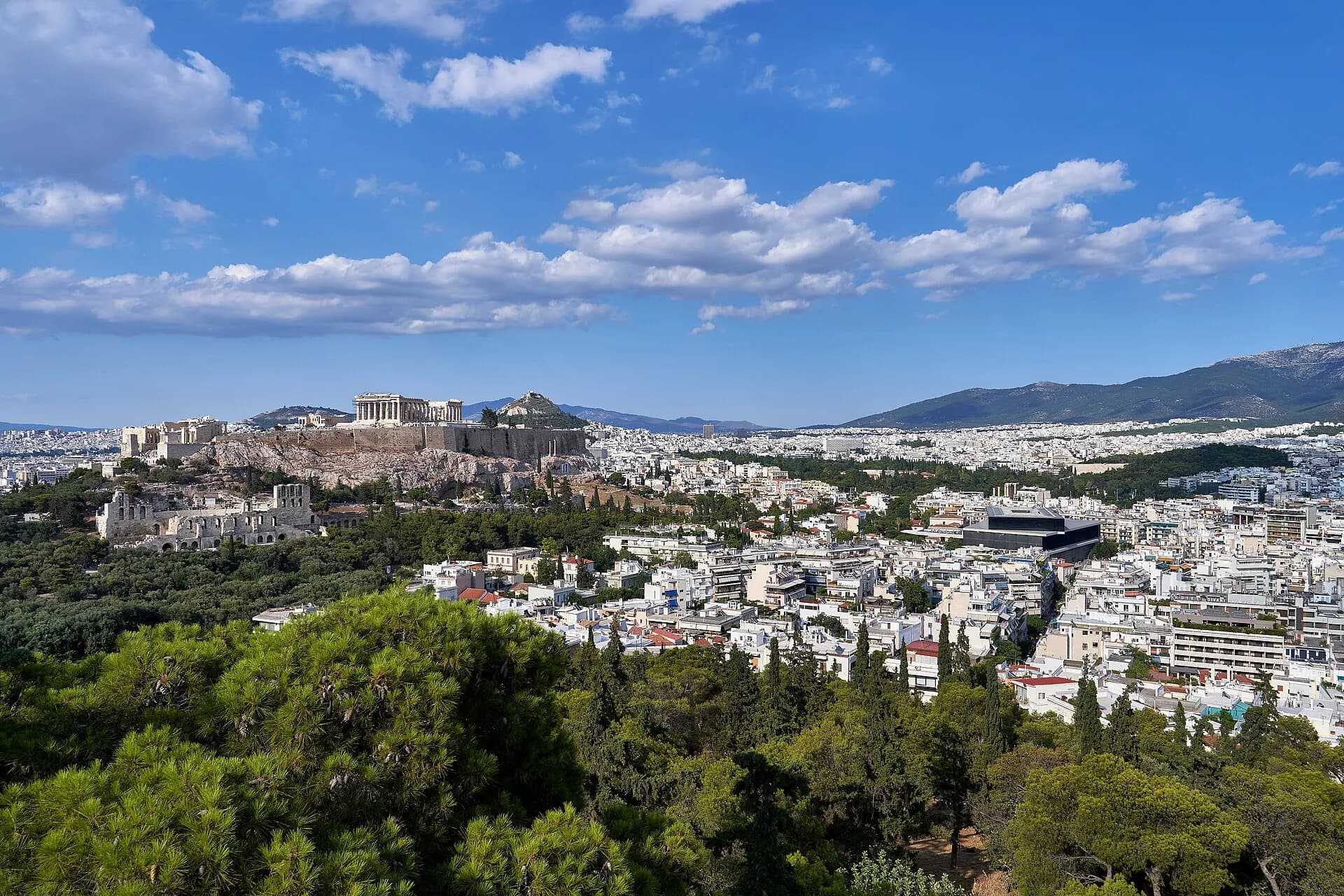
Greece is the mainland of Athens and the Acropolis, Delphi, Meteora and Olympia, the north around Thessaloniki and Epirus, the Peloponnese with Mycenae and Monemvasia, and thousands of islands from Santorini and Mykonos to Crete, Rhodes, Patmos, Corfu and Zakynthos. Mountains, sea, Byzantine churches and ancient ruins sit close together here, and moving between regions by ferry, bus or car is easy. Give the trip time: a week is not enough to see the country.
TripTech will help you choose a flight and a hotel and put together a route for your dates, so travelling around Greece stays comfortable and free of unnecessary transfers.
Where to go in Greece
- 01
Acropolis — see the Parthenon above Athens
The main symbol of Athens: a rock crowned by the Parthenon, the Erechtheion and the temple of Athena Nike, with the city growing around it. The climb starts at the foot of the hill and passes through the Propylaea, where the view opens over the city and the sea. In summer, come early in the morning or towards evening, when there is no heat and no large groups, and bring water. Allow a couple of hours so you are not rushed among the columns and can stop at the viewpoint.
- 02
Delphi — meet the oracle at the temple of Apollo
A sanctuary on the slope of Parnassus where the oracle of Apollo is said to have spoken, while Greek cities kept their offerings here. The temple of Apollo, the treasuries, the theatre and the stadium still stand, and the museum nearby shows the bronze Charioteer. The site is ringed by mountains, and the view over the valley opens up from the road. The climb to the stadium is steep, so wear comfortable shoes and leave enough time.
- 03
Meteora — climb to the monasteries on the rocks
Rock pillars in Thessaly with working monasteries from the 14th to the 16th century on their summits. Monks once climbed up on ropes, and today roads and staircases lead to the houses. Inside, look for frescoes, carved iconostases and small museum collections, while the terraces offer views over the valley. The paths are stony, so wear good shoes, and in the shade at the top it is noticeably cooler than below.
- 04
Rotunda and Hagia Sophia — see the mosaics of Byzantine Thessaloniki
Two monuments that let Thessaloniki call itself a Byzantine city: the Rotunda, built in the time of Galerius, and Hagia Sophia with its massive dome and mosaics. The Rotunda stands on a square, while Hagia Sophia is a few blocks from the waterfront, so both fit into one day. Inside, pay attention to the dome mosaic and the old inscriptions on the walls. It is pleasant to finish on the Nikis waterfront, looking across the bay.
- 05
Ioannina and the island — feel Epirus
A city on Lake Pamvotis in mountainous Epirus, known for its island of quiet lanes and monasteries. Small boats cross to the island, where churches and houses linked to the story of Ali Pasha are worth seeing. In the city, the fortress, the Fethiye Mosque and the old quarters by the lake are the highlights. Ioannina makes a good base for trips to the stone villages of Zagori and the Katara pass.
- 06
Corfu — walk the Venetian old town
An Ionian island whose old town, Kerkyra, is listed by UNESCO for its Venetian architecture. Here you can see narrow alleys, arcades, the church of Saint Spyridon and two fortresses with a walk along the port between them. From town it is easy to head into the hills, to the Pantokrator monastery or to viewpoints above the sea. A car helps you explore the island, though parking in the centre is difficult in high season.
- 07
Zakynthos and Navagio — see the shipwreck bay
An Ionian island known for Navagio bay, where an old ship lies on pale sand beneath sheer cliffs. The viewpoint sits on the cliff edge, and only boats reach the beach itself, so a boat trip is the simplest way to see the bay. The island is also famous for loggerhead turtles that lay eggs on its southern beaches. The slopes above Navagio are sometimes closed after landslides, so check in advance whether the descent is open.
- 08
Olympia — walk the track of the ancient stadium
A sanctuary in Elis where the ancient Olympic Games were held. The ruins of the temple of Zeus, the palaestra and the workshop of Pheidias remain, and the stadium arch leads to a track where symbolic races still take place. Start with the museum: after the finds and models, the ruins are much easier to read. The site is quiet and green, with plenty of shade among the stones, so walking around is restful.
- 09
Mycenae and Epidaurus — see the Lion Gate and the ancient theatre
Two sites in the Argolid that fit into one day. At Mycenae see the Lion Gate, the Treasury of Atreus and the royal tombs; at Epidaurus, the sanctuary of Asclepius and the theatre where a whisper from the centre of the stage reaches the last row. The rocks of Mycenae rise above the plain, and climbing them is easier in the morning before the heat. In season the theatre draws many visitors, so arrive early and carry water.
- 10
Monemvasia and Mystras — see a fortress town and a Byzantine capital
Two monuments of the southern Peloponnese that belong in one trip. Monemvasia is a town fused into a rock by the sea and ringed by walls, while Mystras is a fortified city on a hill above Sparta with churches, frescoes and palaces. A steep road and staircases lead up to Mystras, so wear comfortable shoes and allow time. Monemvasia is worth an overnight stay: in the evening the streets empty and the town looks completely different.
- 11
Patmos — climb to the monastery and the Cave of the Apocalypse
A Dodecanese island linked to Saint John the Divine. The monastery of Saint John stands on a hill above Chora, and below it lies the cave where the Book of Revelation is said to have been written. The monastery is a UNESCO site, and inside you can see frescoes, manuscripts and a library collected over centuries. The climb to the monastery takes time, so set out in the morning and prepare modest clothing in advance.
- 12
Rhodes — walk the streets of the knights' city
A Dodecanese island whose walled old town is a UNESCO site. Here the streets of the Knights Hospitaller sit beside mosques, synagogues and houses from different eras, and columns by the port are a favourite evening walk. See the Palace of the Grand Master, the Street of the Knights and the old harbour where boats leave. Lindos and the beaches of the east coast are easy day trips, and the city itself is best explored on foot.
- 13
Santorini — watch the sunset over the caldera
A Cycladic island where white towns stand on the edge of the caldera and volcanic cliffs rise from the sea. In Oia and Fira the viewpoints hang above the water, and below them a trail runs from Fira to Oia. The beaches are volcanic, with black pebbles, red and white sand, and each has its own road. The sunset in Oia draws a crowd, so claim a spot early, and buses are the easiest way between the towns.
- 14
Mykonos — see white lanes and windmills
A Cycladic island known for white houses with coloured shutters, narrow lanes and windmills on the hill. In the centre, see Little Venice, the small churches and chapels, while the beaches offer lively days and clear water. The old town is a maze, so a map helps, though getting lost here is a pleasure. In summer the island is very popular, so walk in the morning before the streets fill up.
- 15
Knossos — walk the Minoan palace and recall the Minotaur
A Bronze Age palace complex near Heraklion, regarded as the palace of King Minos and tied to the legend of the Minotaur. Here you can see the throne room, storerooms full of giant pithoi and frescoes of bull-leaping, while part of the site has been reconstructed and therefore looks unusual. Most of the complex is open to the sun, so in summer come early in the morning or towards evening. The visit pairs well with the museum in Heraklion, which keeps the finds from the site.
- 16
Chania — feel Venetian Crete
A city in western Crete with a Venetian quarter, an old harbour and a lighthouse. Here you can see the alleys around the port, the maritime museum, the Etz Hayyim synagogue and traces of the Venetian fortifications. From the city it is easy to head for the Samaria Gorge, the Akrotiri peninsula and the quieter beaches of the west coast. Chania has plenty of cafés along the waterfront, so keep the evening free and take your time.
Resorts and cities
What else is worth trying
Try a Greek breakfast
bread with olive oil, cheese, yoghurt with honey and strong coffee, taken slowly — in Greece it is a ritual of its own.
Take a ferry
between the islands or out of Piraeus to see how the country looks from the water and to reach small harbours.
Rent a car
on the mainland or a large island to reach viewpoints, old villages and beaches that buses do not serve.
Sit in a taverna
with meze, fresh fish and local wine at a table by the water, unhurried and with conversation.
Swim in different seas
on the Aegean, Ionian and Cretan coasts — each has its own character, temperature and colour of water.
Before your trip
Weather in Greece depends on the region and the season: summers on the islands are hot and dry, the mountains of Epirus and Thessaly stay cooler, and spring and autumn suit sightseeing in Athens and the Peloponnese. Ferries link the mainland and the islands, but timetables depend on the wind, and in high season seats are worth looking for in advance. In working monasteries such as Meteora and Patmos, shoulders and knees need to be covered, so pack a light wrap. Cards are widely accepted, yet small tavernas, ferries and kiosks often need cash. Book a rental car ahead if you plan to drive around the Peloponnese or Crete: roads are narrow, parking in towns is limited, and your driving licence must meet the rental conditions.
Frequently asked questions
When is the best time to visit Greece?
May, June and September are the most comfortable for sightseeing in Athens and the Peloponnese, when the heat is not exhausting. The islands come alive from May to October, while July and August are very hot and busy. In winter the mainland is quieter and cooler and part of the island season closes, but it is a calm time for city walks.
How many days do you need in Greece?
Four or five days are enough for Athens and one trip nearby. Add the Peloponnese or Meteora and a week to ten days makes sense, while a route with two or three islands and Crete needs two weeks or more. Ferries between islands take hours, so transfers eat into the time.
Should you choose the islands or the mainland?
The mainland is about antiquity, Byzantine churches, mountains and big cities; the islands are about the sea, beaches and a slower rhythm. It makes sense to start a first trip in Athens and the Peloponnese and finish on an island that is easy to reach by ferry or plane.
How do you get around Greece?
Ferries and flights link the mainland and the islands, while buses and trains connect mainland cities. On the islands and in rural parts of the Peloponnese and Crete a car is easiest, whereas in Athens and Thessaloniki the metro and buses beat looking for parking.
Information about places and trip conditions may change or be out of date. Please verify the latest details before you travel.
Photograph: George E. Koronaios · CC BY-SA 4.0 · Wikimedia Commons