

Resort guide
Tashkent — Uzbekistan
Tashkent, Uzbekistan: holidays and tours. We compare hotels, flights, meals and transfers and check the terms before payment. Tell us your dates and budget and a manager will match options for your trip.
TripTech will help you choose a flight and a hotel and put together a route between Tashkent, Samarkand, Bukhara and Khiva for your dates, so travelling around Uzbekistan stays comfortable and free of unnecessary transfers.
Where to go: Tashkent and nearby
Start with the resort itself, then add the country highlights that fit your route.
- 01
Khast-Imam — see the oldest shrines of Tashkent
An architectural complex in the old part of Tashkent, formed around the mausoleum of the saint Kaffal Shashi. It holds the Barak Khan Madrasa, the Hazrati Imam Mosque and a library keeping one of the oldest copies of the Quran. The place feels local rather than touristy: residents come here, and the courtyards stay quiet even at weekends. Old quarters survive around the complex and are pleasant to walk through afterwards.
- 02
Chorsu Bazaar — step into everyday Tashkent
A large domed market in the centre of old Tashkent, where traders sell flatbread, dried apricots, spices, pomegranates and herbs. A square with a metro station surrounds the bazaar, so it is easy to stop by on the way to other sights. Come in the morning, while the stalls are full and the heat has not set in yet. You can also buy souvenirs and tea here, and traders are happy to say where their goods come from.
- 03
Chimgan and Charvak — trade the city for mountains and water
A mountain area in Tashkent region, visited for a day or a weekend: the Chimgan ridge with its chairlift, green slopes and the Charvak Reservoir with its holiday camps. Here you can walk the trails, ride horses, climb to viewpoints and swim by the water. The road from Tashkent is short, which makes it a popular dawn trip.
- 04
Khudoyar Khan Palace — understand the Kokand khanate
A palace complex in Kokand built in the 19th century under Umar Khan and Khudoyar Khan, with a richly decorated facade, carved ganch and an inner courtyard. A mosque and a minaret stand nearby, and the historic centre is small and easy to walk. Kokand lies in the Fergana Valley, so it fits naturally into a trip around the valley.
- 05
Registan — stand on the square of the Silk Road
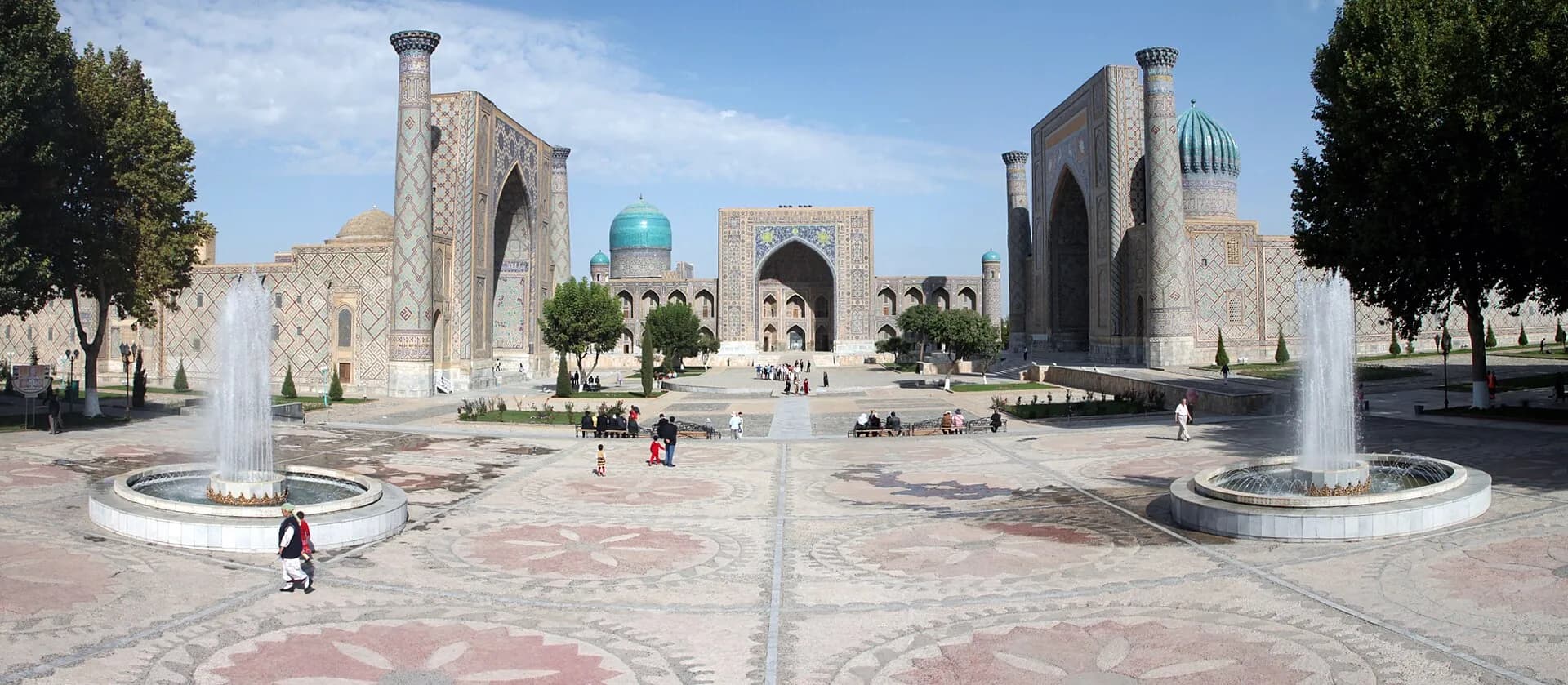
The main square of Samarkand, framed by three madrasas: Ulugbek, Sher-Dor and Tilla-Kari. Turquoise domes, portals and tile ornament are visible from every corner, and the lights come on in the evening. The square is still the heart of the city, with workshops, souvenir shops and cafés around it, so it is easy to wander here between excursions.
- 06
Gur-Emir — see the tomb of Tamerlane
A mausoleum in Samarkand where Amir Timur and his descendants, including Ulugbek, are buried. Inside are a tall domed hall, marble tombstones and gold painting, while outside the building is recognised by its ribbed turquoise dome. It is a short but powerful stop, best seen together with the Registan. A short street with souvenir shops links the square and the mausoleum.
Other resorts: Uzbekistan
What else is worth trying
Try plov
real Uzbek plov is cooked in a kazan and differs from town to town: rice, carrots, meat and cumin, served with green tea.
Sit in a tea house
a slow pot of tea with flatbread, dried fruit and sweets is the local way to wait out the heat and talk.
Hire a car with a driver
for the mountains, the lakes and the Aral Sea, where public transport is rare and slow.
Plan the city route
Tashkent, Samarkand, Bukhara and Khiva form a logical chain, but leave a few days without excursions between them.
Buy ceramics and fabric
Rishtan and Margilan are known for pottery and silk, and bazaars are good for atlas silk, cotton and hammered metal.
Before your trip
Spring and autumn are the best seasons: summer is very hot in the desert and the cities, while winter is cold and damp in the north. Trains and flights link Tashkent, Samarkand, Bukhara and Khiva, and a car is the practical way to reach the mountains, the lakes and the Aral Sea. Cash matters in villages, at bazaars and in small cafés, though cards are accepted more often in the cities. In working mosques and mausoleums, dress modestly: cover shoulders and knees, and women may need a scarf. Tea is drunk often and in quantity, plov is ordered for a group, and it is worth asking locals where the best plov is. Foreign visitors should remember temporary registration: hotels usually arrange it, but keep your passport with you.
Frequently asked questions
How much does a tour to Tashkent cost?
The price depends on dates, hotel, meal plan, flights and party size. A manager will shortlist options for your budget and show the full price before payment.
When is the best time to visit Tashkent?
The best season depends on your dates, budget and holiday style. A manager will check current options for your specific dates.
Can I depart from my city?
We search departures from Almaty, Astana and other cities in Kazakhstan; availability depends on dates and flights.
Do you help with documents?
We check current requirements for your citizenship and help prepare documents. The visa decision is made by the consulate.
When is the best time to visit Uzbekistan?
April and May or September and October suit the Silk Road cities best: the days are warm, the evenings cool and the bazaars full of fruit. Summer is very hot in Bukhara and Khiva, though the mountains and lakes are more comfortable then, and winter is colder and quieter in Tashkent and Samarkand.
How many days do you need in Uzbekistan?
A week is enough for Tashkent, Samarkand and Bukhara at a relaxed pace. The classic four-city route takes about ten to twelve days, and with the Fergana Valley, the mountains and the Aral Sea it is worth allowing two weeks or more.
Information about places and trip conditions may change or be out of date. Please verify the latest details before you travel.
Photograph: Stomac · CC BY-SA 2.0 fr · Wikimedia Commons